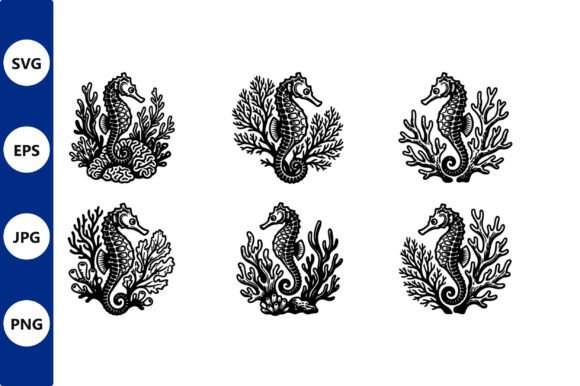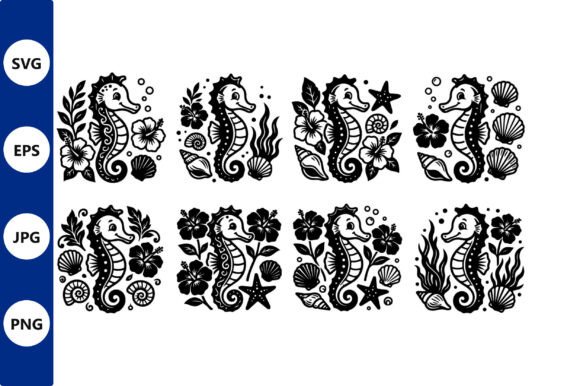
Seahorse Undersea Line Art Black White: A Comprehensive Guide to Nautical Vector Design
In the realm of digital illustration and print design, the intersection of marine biology and minimalist aesthetics has given rise to a distinct visual language. Among the most captivating subjects within this niche is the seahorse, an organism whose natural curves and intricate textures translate exceptionally well into monochromatic formats. The Seahorse Undersea Line Art Black White style represents more than just a simple drawing; it is a sophisticated approach to capturing the essence of the ocean through contrast, pattern, and negative space. This design philosophy strips away color to focus on form, allowing creators to emphasize the delicate anatomy of the creature while integrating it seamlessly with its environment.
The appeal of this specific artistic direction lies in its versatility. Whether utilized for high-end interior decor, personal body art, or commercial branding, the stark contrast between black ink and white backgrounds creates a timeless look that transcends fleeting trends. By surrounding the central subject with coral, shells, and seaweed, artists can build complex narratives within a single frame, turning a biological sketch into a decorative masterpiece suitable for various creative workflows.
The Anatomy of Monochromatic Marine Illustration
Understanding the mechanics behind successful line art requires a deep appreciation for how lines define volume and texture without the aid of shading or gradients. In a black and white vector scene, every stroke must carry weight. When depicting a seahorse, the artist must navigate the creature's unique morphology—its prehensile tail, tubular snout, and bony plates—with precision. The resulting image relies heavily on the interplay between positive and negative space.
The inclusion of surrounding elements such as coral reefs, scattered shells, and flowing seaweed serves a dual purpose. First, it provides context, grounding the seahorse in its natural habitat. Second, these elements introduce varied patterns that contrast with the smoother curves of the animal itself. For instance, the jagged edges of coral can be rendered with sharp, angular lines, while the seaweed might be depicted using fluid, sweeping strokes. This variation in line quality adds depth and visual interest, preventing the composition from feeling flat despite the absence of color.
This approach to patterning is particularly effective for nautical design projects where clarity and elegance are paramount. The high-contrast nature of the artwork ensures that details remain visible even when scaled down for small applications like decals or scaled up for large wall murals. The decision to use a strictly black and white palette also allows the design to adapt easily to different substrates, from glossy paper to textured fabric, without worrying about color fidelity issues.
Technical Foundations: Vectors and Scalability
From a technical standpoint, the creation of these images relies heavily on vector graphics software. Unlike raster images, which are composed of pixels and can lose quality when enlarged, vector files are mathematically defined paths. This characteristic makes them ideal for the Seahorse Undersea Line Art Black White genre, where crisp edges and clean lines are non-negotiable. The ability to scale a design from a business card size to a billboard without any loss of resolution is a significant advantage for professional designers and hobbyists alike.
When a digital download includes formats such as SVG (Scalable Vector Graphics) and EPS (Encapsulated PostScript), it ensures compatibility across a wide range of industry-standard software. These formats allow users to manipulate individual elements of the scene. For example, a designer might want to separate the seahorse from the background coral to create a layered effect or change the line weight to suit a specific printing technique. The fact that each design is individually cleaned up and optimized means that the nodes and paths are streamlined, reducing file size while maintaining maximum detail.
Raster formats like PNG and JPG are also essential components of a comprehensive digital asset pack. While they lack the scalability of vectors, they offer immediate usability for web design, social media graphics, and quick mockups. A PNG file with a transparent background, for instance, allows the line art to be overlaid onto colored backgrounds or photographs, expanding the creative possibilities beyond traditional white-space compositions.
Practical Applications in Creative Industries
The utility of high-quality marine line art extends far beyond the screen. Its primary strength lies in its adaptability for physical production. One of the most popular uses is in the creation of custom wall art. Homeowners and interior designers often seek prints that add character to a room without overwhelming the existing color scheme. A large-scale print of a seahorse surrounded by intricate seaweed patterns can serve as a focal point in a coastal-themed living room or a serene bedroom, offering a sense of calm and connection to nature.
In the realm of fashion and textiles, these designs are frequently used for screen printing on t-shirts, tote bags, and fabric swatches. The bold lines of the black and white vector scene reproduce beautifully on cotton and linen, ensuring that the fine details of the shells and coral remain sharp after washing. The simplicity of the palette also makes it easier to match with various clothing colors, making it a versatile choice for apparel brands looking to expand their nautical collections.
Tattoo artists also find immense value in this style of illustration. Line work tattoos have seen a resurgence in popularity due to their elegant and understated appearance. The intricate patterning found in seahorse designs offers tattooists a rich source of inspiration for sleeves, back pieces, or smaller accent tattoos. Because the designs are pre-optimized and cleaned up, artists can import the files directly into their workflow, saving time on digitization and allowing them to focus on the application process.
Commercial Decals and Branding
For business owners, particularly those in the maritime, tourism, or lifestyle sectors, personalized decals offer a cost-effective way to brand vehicles, equipment, or retail spaces. The durability of vinyl cutting machines combined with the precision of vector line art results in long-lasting, professional-grade signage. A coffee shop with a beach theme, for example, might use a seahorse decal on its windows to attract customers, leveraging the recognizable imagery to establish a cohesive brand identity.
Furthermore, these assets are invaluable for packaging design. Luxury product lines often utilize minimalistic, high-contrast graphics to convey sophistication. Placing a detailed seahorse illustration on a cosmetic jar, a bottle of artisanal soap, or a box of gourmet treats can elevate the perceived value of the product. The intricate details of the line art suggest craftsmanship and attention to detail, qualities that consumers associate with premium goods.
Workflow Integration for Creators and Educators
Integrating digital downloads into a creative workflow is straightforward, provided the user has access to compatible software. The process typically begins with selecting the appropriate file format based on the intended output. For print-on-demand services, SVG or EPS files are usually preferred to ensure the highest quality reproduction. Once imported, the creator can adjust the dimensions, rotate the orientation, or combine multiple elements to create a unique layout.
Educators in art and design programs can utilize these resources to teach students about composition, negative space, and the principles of vector drawing. By analyzing a Seahorse Undersea Line Art Black White image, students can learn how to balance complex organic shapes with geometric patterns. They can experiment with modifying the line weights or adding their own elements to the scene, fostering creativity while adhering to established design principles.
Researchers and illustrators focusing on marine life may also find these stylized representations useful for educational materials. While not scientifically accurate in every anatomical detail, the artistic interpretation highlights key features of the seahorse and its ecosystem in a way that is accessible and engaging for a general audience. This can be particularly effective in children's books, museum exhibits, or conservation awareness campaigns where visual appeal is crucial for engagement.
Considerations for Customization and Adaptation
While the convenience of ready-to-use files is a major advantage, creators should consider the nuances of customization. Even though the designs are optimized, slight adjustments may be necessary depending on the specific requirements of a project. For instance, if a design is intended for a very small application, some of the finer details in the seaweed or shells might need to be simplified to maintain legibility. Conversely, for large-scale installations, adding additional layers of complexity could enhance the visual impact.
It is also important to consider the context in which the art will be displayed. The stark contrast of black and white works best in environments with ample lighting or against neutral backgrounds. If the design is to be placed on a dark surface, the color values may need to be inverted, or the line weight increased to ensure visibility. Understanding these environmental factors allows creators to maximize the effectiveness of the Seahorse Undersea Line Art Black White aesthetic in any setting.
Evolution of Nautical Design Trends
The enduring popularity of nautical themes in design reflects a broader cultural fascination with the ocean and its mysteries. As modern design trends shift towards minimalism and sustainability, the clean lines and eco-friendly messaging associated with marine life illustrations resonate deeply with contemporary audiences. The move away from photorealistic, colorful renderings toward stylized, monochromatic line art signals a desire for authenticity and artistic integrity.
This trend is evident across various platforms, from social media influencers sharing their DIY home decor projects to high-end galleries showcasing limited edition prints. The Seahorse Undersea Line Art Black White style fits perfectly into this narrative, offering a bridge between traditional maritime heritage and modern aesthetic sensibilities. It appeals to a diverse demographic, ranging from young entrepreneurs starting their creative businesses to seasoned professionals seeking fresh inspiration for their portfolios.
As technology continues to advance, the tools available for creating and manipulating these designs will only become more sophisticated. However, the core principles of good design—clarity, balance, and emotional resonance—remain unchanged. The ability to capture the spirit of the underwater world through simple yet powerful lines ensures that this style will remain relevant for years to come, continuing to inspire creators and captivate audiences around the globe.